

How Can You Get Better at Boxing With 6 Essential Tips?
You can get better at boxing by first mastering your stance, footwork, and basic punches to build a solid foundation. Use shadow boxing to sharpen your technique and timing while building muscle memory.
Focus on a strong defense with proper guard and head movement. Boost your endurance and power through conditioning workouts.
Gain confidence with regular sparring to apply skills in real situations. By studying professional fighters, you’ll enhance your strategy and take your training further.
Master the Basics: Perfect Your Stance, Punches, and Footwork

Mastering the basics is essential if you want to improve your boxing skills. To perfect your stance, position your feet shoulder-width apart with your lead foot forward. Lean your weight slightly ahead to boost balance and mobility.
When working on punches like the jab, hook, and uppercut, focus on precise body movement. Keep your rear hand up to guard against counterattacks.
Your footwork is just as important. Take small, controlled steps in all directions, staying light on your feet to maintain balance and create angles for attack.
Use Shadow Boxing to Improve Skills and Timing
Shadow boxing lets you sharpen your technique, timing, and spatial awareness without the pressure of an opponent. It’s an essential tool that helps you practice punches, footwork, and defensive moves in a controlled setting.
Shadow boxing hones your technique, timing, and spatial awareness without needing an opponent.
To get the most from shadow boxing, focus on these key points:
- Practice in front of a mirror to spot and correct mistakes, ensuring your form stays precise.
- Visualize an opponent to maintain your defensive posture and react instinctively.
- Build muscle memory by repeating combinations, so your movements become quicker and more accurate.
- Take breaks to self-assess and refine your technique, promoting continuous improvement.
Incorporate shadow boxing regularly, and you’ll see your skills and timing improve considerably.
It really makes a difference when you keep at it consistently.
Build a Strong Defense: Guard, Head Movement & Blocking
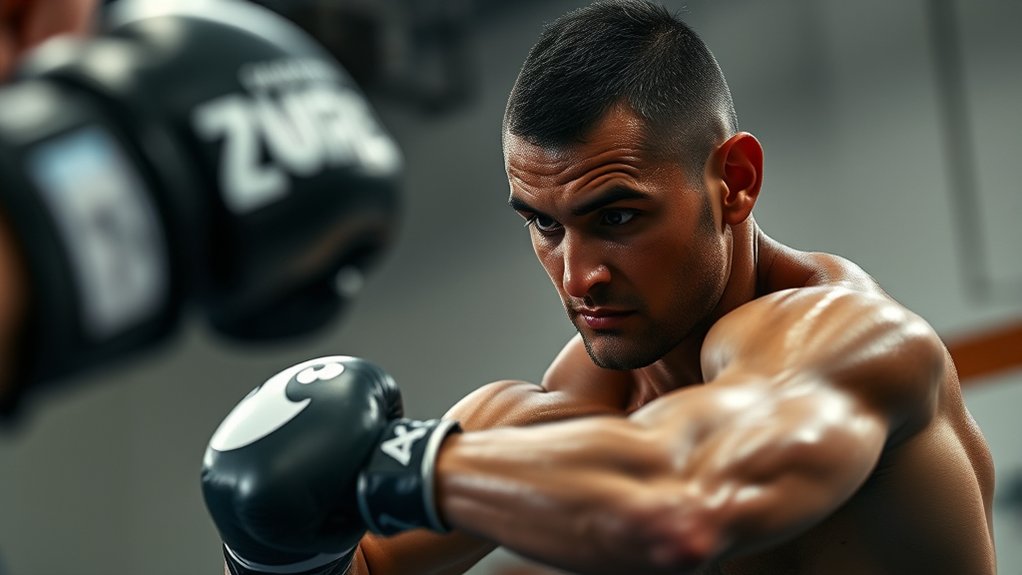
While offense wins fights, a strong defense keeps you standing longer and sets up your counterattacks. Start by mastering your guard. Keep your hands high, elbows down, and chin tucked to shield yourself from punches while staying ready to strike back.
Combine this with effective head movement like slipping and bobbing to dodge attacks without losing your offensive stance. Practice blocking to absorb and deflect punches, minimizing damage and prolonging your endurance in the ring.
Incorporate defensive drills during shadow boxing to build muscle memory and sharpen your reaction time. Finally, spar regularly to apply your guard, head movement, and blocking skills against real opponents. This helps enhance your timing and adaptability.
A solid defense is key to controlling the fight and creating openings for your counters.
Boost Your Conditioning for Endurance and Power
If you want to boost your boxing endurance and power, start by focusing on cardiovascular training. Activities like running or biking are great for keeping your energy levels high throughout your rounds.
Next, add in some strength exercises and explosive movements. These will help increase both the force and speed of your punches.
And hey, don’t forget about recovery and proper nutrition. They’re absolutely key to sustaining your performance and preventing injuries in the long run.
Cardiovascular Endurance Training
Because boxing demands bursts of intense effort followed by brief recovery, you need cardiovascular endurance training to keep your stamina high throughout every round. This training helps you maintain energy, recover faster, and deliver powerful punches consistently.
To improve your cardiovascular endurance training, focus on:
- High-Intensity Interval Training (HIIT) to simulate fight conditions and boost aerobic and anaerobic fitness.
- Running and biking to build overall cardiovascular capacity and leg strength.
- Agility ladder drills to enhance footwork, speed, and coordination.
- Consistent endurance workouts to reduce recovery time between rounds and sustain performance.
Stick with these, and you’ll notice your stamina and power holding up much better as the rounds go on. It’s all about training your body to keep going strong when it counts!
Strength and Power Exercises
Building your cardiovascular endurance sets the foundation, but developing strength and power takes your boxing conditioning to the next level. Incorporate strength and power exercises focusing on lower body moves like squats and deadlifts to build the kinetic chain essential for powerful punches.
Don’t skip unilateral exercises such as single-leg squats. They fix imbalances and boost stability during bouts.
For upper body strength, include dumbbell chest presses and pull-ups to enhance force transfer and maintain shoulder mobility, which reduces injury risk.
Core training is equally crucial. It links your lower and upper body, improving punch snap and control over flexion and rotation.
Recovery and Nutrition Strategies
Although training hard is essential, you can’t maximize your boxing gains without proper recovery and nutrition.
Recovery and nutrition strategies play a vital role in boosting your endurance and power.
Focus on these four key areas:
- Prioritize 7-9 hours of quality sleep nightly to support muscle repair and enhance overall performance.
- Stay hydrated by drinking at least half your body weight in ounces of water daily to optimize recovery.
- Follow a balanced diet rich in lean proteins, complex carbs, and healthy fats, aiming for 1.2 to 2.0 grams of protein per kilogram of body weight.
- Consume a protein-rich snack or meal within 30 minutes post-training to replenish energy and promote muscle recovery.
Build Confidence With Regular Sparring
When you spar regularly, you sharpen your timing and reflexes by applying techniques against a live opponent. This hands-on practice helps you develop essential boxing skills in a dynamic, unpredictable setting.
Sparring lets you experiment with punches and defensive moves, boosting your confidence as you see what works in real time. Facing controlled hits during sessions builds your mental toughness, making you more comfortable handling pressure in the ring.
To maximize growth, spar with partners who challenge you slightly, pushing your limits while keeping the experience safe and constructive.
Over time, consistent sparring prepares you for the unpredictability of actual fights, making your boxing skills sharper and your confidence stronger every session.
Learn From the Pros: Study Fighters’ Styles and Strategies

If you want to elevate your boxing skills, studying professional fighters’ styles and strategies can provide invaluable insights. To learn from the pros effectively during your boxing training, focus on these key steps:
- Analyze fight footage to identify effective combinations and unique techniques.
- Observe defensive maneuvers to improve your own defense and create counterattacking openings.
- Slow down and replay matches to fully understand timing and movement.
- Use online tutorials featuring pros, but prioritize hands-on practice for skill development.
By breaking down what the pros do, you’ll pick up moves and tactics that can seriously up your game.
Watching and re-watching helps you catch details you might miss the first time around.
Then, take what you’ve learned and get in the ring to put it all into practice.
Frequently Asked Questions
What Are the Best Strength Exercises to Complement Boxing Training?
To complement your boxing training, focus on strength conditioning with squats and deadlifts to build explosive lower body power.
Include unilateral exercises like single-leg movements to fix imbalances and boost mobility.
For upper body, prioritize pressing moves such as strict press-ups and dumbbell chest presses to enhance hand speed without adding bulk.
Don’t forget core work. Train for stability, strength, and explosiveness to connect your punches and prevent injuries effectively.
How Important Is Nutrition for Boxing Performance and Recovery?
Nutrition is essential for your boxing performance and recovery. Proper nutrition timing guarantees you fuel your body before intense training and aid muscle repair afterward.
Eating complex carbs and proteins at the right times boosts your energy and helps your muscles recover faster. Staying hydrated and choosing nutrient-dense foods post-workout keeps you strong and ready for the next round.
Without good nutrition timing, you’ll struggle with endurance and recovery. And that can really limit your progress in the ring.
Can Mental Training Improve My Boxing Focus and Confidence?
Yes, mental training can definitely improve your boxing focus and confidence. By using mental visualization, you create strong images of successful moves and victories in your mind, which boosts your self-belief.
When you regularly practice this, you reinforce a positive mindset that keeps you calm and focused during matches.
Combining mental visualization with positive self-talk helps you stay motivated and confident.
This makes your overall performance sharper and more consistent in the ring.
How Often Should I Rest to Prevent Boxing Injuries?
You should rest at least one to two full days each week to prevent boxing injuries.
Recovery techniques like active recovery, such as light walking or yoga, help keep your muscles loose without overexerting yourself.
Prioritize quality sleep, aiming for 7-9 hours.
And listen to your body. If you’re overly sore or fatigued, extend your rest.
Staying hydrated and eating nutrient-rich foods also support muscle repair and reduce injury risk during training.
Taking care of these basics really makes a difference.
What Gear Is Essential for Safe and Effective Boxing Practice?
Think of essential gear as your armor in the boxing battlefield. It keeps you safe and sharp.
You’ll want quality boxing gloves with proper padding to shield your hands, hand wraps to support your wrists, and a mouthguard to protect your smile and brain.
Don’t forget sturdy boxing shoes for quick, stable footwork and a heavy bag to build power and technique.
With this essential gear, you’re set for safe, effective training. It’s all about having the right equipment to boost your performance and keep injuries at bay.
Conclusion
By mastering these six essential tips, you’ll transform your boxing skills faster than a lightning-fast jab! Perfect your stance and footwork, shadow box to sharpen timing, and build a rock-solid defense.
Boost your conditioning to power through rounds, spar regularly to build confidence, and study the pros to elevate your strategy. Stick with it, and you’ll not only get better—you’ll feel unstoppable every time you step into the ring.
Keep fighting, champ!


