
Can Boxing Cause Parkinson’s Disease?
Yes, if you box and take repeated head hits, your risk of developing Parkinson’s disease goes up considerably. These blows can damage dopamine-producing brain cells, leading to symptoms like tremors, stiffness, and slow movement.
Boxing-related brain injuries can trigger a degenerative process similar to Parkinson’s. Experts emphasize safety and monitoring to protect brain health. Understanding how these injuries contribute to the disease reveals important insights into prevention and long-term effects.
How Parkinson’s Disease Develops in the Brain
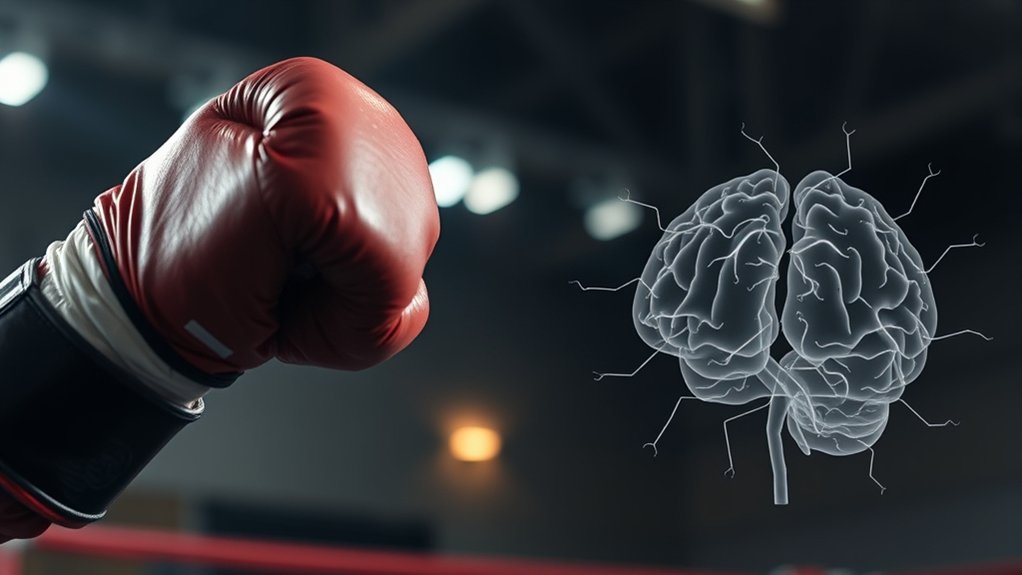
Although Parkinson’s disease is complex, it develops primarily through the progressive loss of dopamine-producing nerve cells in a brain region called the substantia nigra.
You should know that these neurons are essential because dopamine helps coordinate your movements smoothly. When these cells deteriorate, you’ll notice the classic symptoms like tremors, stiffness, and slowed movement.
Head trauma can play a significant role in this process. It may trigger a degenerative cascade, accelerating nerve cell loss and contributing to Parkinson’s disease development. If you’ve experienced repeated head injuries, especially from activities like boxing, your risk might increase.
Genetics also interact with environmental factors like head trauma, making some people more vulnerable.
Understanding how Parkinson’s disease develops in the brain helps you grasp why protecting your head is so important.
What Evidence Links Head Trauma to Parkinson’s Disease?
Head trauma doesn’t just cause immediate injury; it can also set off a chain reaction that increases your risk of developing Parkinson’s disease. Studies reveal a clear link between head injury and Parkinson’s disease, especially when injuries are repeated or severe.
For example, a 2006 study found that twins with a history of head injury were more likely to develop Parkinson’s, pointing to a strong correlation. Medical research shows that traumatic brain injury can trigger degenerative processes that lead to Parkinson’s symptoms.
Neurologists recognize that head trauma from sports, including boxing, raises your chances of neurodegenerative diseases. The frequency and intensity of concussions you experience play a vital role in increasing your risk of Parkinson’s disease later on.
How Repeated Head Injuries From Boxing Damage the Brain
When you repeatedly endure blows to the head in boxing, your brain undergoes damage that can accumulate over time, leading to serious neurological problems.
Repeated head blows in boxing cause cumulative brain damage, risking long-term neurological problems.
These repeated hits cause traumatic brain injury, which can trigger a degenerative process damaging dopamine-producing cells essential for motor control.
This damage doesn’t just happen instantly; it builds up with every concussion or sub-concussive impact, increasing your risk of chronic traumatic brain injury (CTBI).
CTBI often leads to cognitive, motor, and behavioral issues that may surface long after you stop boxing.
Studies show that boxers with numerous professional bouts face a higher likelihood of developing neurodegenerative disorders, including Parkinson’s disease.
Understanding how these repeated head injuries harm your brain highlights the serious risks boxing poses to your long-term neurological health.
What Symptoms in Boxers Resemble Parkinson’s Disease?
You know, boxers often show motor symptoms that look a lot like Parkinson’s disease—things like tremors and slower movements.
But it’s not just about the physical stuff. They can also have cognitive problems, like memory loss and slower thinking.
On top of that, behavioral changes such as irritability often make things even tougher for them after spending years in the ring.
Motor Symptoms in Boxing
Several motor symptoms in boxers closely resemble those seen in Parkinson’s disease, including tremors, rigidity, and slurred speech. These motor symptoms often result from repeated brain trauma sustained during boxing.
You might notice poor coordination and bradykinesia, which is slowness of movement, common in both conditions.
Studies show retired boxers with a history of multiple bouts frequently develop parkinsonism. The severity of these symptoms is linked to the extent of their brain injuries. This condition, called pugilistic parkinsonism, mirrors idiopathic Parkinson’s disease, making it hard to distinguish between the two.
If you’ve experienced multiple concussions or a lengthy boxing career, the cumulative brain trauma greatly raises your risk of developing these motor impairments.
It really highlights the lasting impact boxing can have on your neurological health.
Cognitive And Behavioral Changes
Although motor symptoms often receive the most attention, cognitive and behavioral changes in boxers closely resemble those seen in Parkinson’s disease. You might notice cognitive issues like memory deficits and slowed mental processing, which mirror Parkinson’s symptoms.
Behavioral changes are equally significant. Irritability and violent outbursts, common in boxers with chronic traumatic brain injury, resemble Parkinson’s-related behavioral problems. These symptoms often emerge years after you retire, much like Parkinson’s delayed onset after head trauma.
Furthermore, motor difficulties such as slurred speech and poor coordination further blur the lines between boxing-related brain injuries and Parkinson’s disease.
Understanding these cognitive and behavioral changes helps reveal the profound neurological impact boxing can have, highlighting the need for awareness and early intervention.
What Muhammad Ali’s Medical History Shows About His Parkinson’s
You’ll notice that Ali was diagnosed with Parkinson’s several years after he’d already stopped boxing.
That makes it tricky to say for sure that his career caused the disease.
When doctors did his neurological exams, they found the usual Parkinson’s symptoms, and these symptoms responded well to treatment.
Ali’s Diagnosis Timeline
Muhammad Ali’s journey with Parkinson’s disease began to surface during his boxing career. Symptoms like tremors and slowed movements gradually became apparent. Though he was officially diagnosed in 1984, that was years after he retired.
Ali’s medical history shows a clear progression of Parkinson’s disease over time. His doctors, including Dr. Mahlon R. DeLong and Dr. Michael S. Okun, tracked worsening symptoms such as bradykinesia for more than two decades.
Diagnostic scans in the late 1990s confirmed characteristic brain changes consistent with Parkinson’s.
Early responsiveness to levodopa highlighted the disease’s impact on his motor skills.
It’s important to note that while head trauma from boxing likely increased his risk, medical experts made it clear that Ali’s condition was different from post-traumatic tremor.
This distinction shows how complex Parkinson’s disease origins can be in cases like his.
Neurological Findings Summary
Understanding the neurological progression of Parkinson’s disease requires careful analysis of clinical and imaging data.
Muhammad Ali’s medical history shows that his diagnosis was supported by a 1997 FDG-PET scan revealing progressive bilateral striatal hyperactivity consistent with Parkinson’s disease.
You’d notice his left-sided hand tremor and rigidity improved with levodopa, matching classic Parkinson’s symptoms.
Serial neuropsychological tests showed worsening frontal and memory impairments, setting his condition apart from temporary post-traumatic tremors.
Although head trauma from boxing is a known risk factor, Ali’s medical team found no definitive link between his career and the disease.
They emphasized that accurate diagnosis depends on thorough in-person exams and historical records, highlighting the complexity of Parkinson’s disease beyond just head injuries.
How Brain Scans Support Parkinson’s Diagnosis in Boxers
Although diagnosing Parkinson’s disease in boxers can be challenging, brain scans like FDG-PET and F-DOPA PET have provided clear evidence supporting the diagnosis. These imaging techniques reveal essential neurological changes that clinical exams alone might miss.
Here’s how brain scans support Parkinson’s diagnosis in boxers:
Brain scans reveal critical neurological changes that aid in diagnosing Parkinson’s disease in boxers.
- FDG-PET scans show low striatal uptake, indicating reduced dopamine activity linked to Parkinson’s disease, as seen in Muhammad Ali.
- Progressive bilateral striatal hyperactivity detected on these scans reflects neurodegenerative changes typical of Parkinson’s.
- Combining imaging results with neuropsychological tests helps distinguish idiopathic Parkinson’s disease from trauma-induced tremors common in boxers.
What Studies Reveal About Parkinson’s Prevalence in Retired Boxers
Several studies have examined how common Parkinson’s disease is among retired boxers, revealing notable patterns. Research shows that parkinsonism affects a small but significant portion of retired boxers, particularly those with extensive exposure to head injuries.
For example, Thai traditional boxers with over 100 bouts have a higher risk of developing Parkinson’s disease (PD). Age also plays a key role, with prevalence rising sharply after 50.
| Factor | Observation | Impact on Parkinson’s Risk |
|---|---|---|
| Parkinsonism Prevalence | 1.14% in retired Thai boxers | Indicates notable presence |
| PD Prevalence | 0.71%, increasing with age | Age is a critical factor |
| Number of Bouts | >100 bouts linked to PD (P=0.01) | Repetitive head injuries increase risk |
| Age | Older age correlates with higher PD | Age amplifies effects of head trauma |
These findings support the link between chronic head injuries and parkinsonism in boxers. It really highlights how repeated trauma and aging together increase the risk.
How Genetics and Environment Affect Parkinson’s Risk in Boxers
Because both genetics and environment shape Parkinson’s risk, boxers face a unique challenge when it comes to the disease. You need to understand how genetic mutations and head trauma interact to influence your risk.
Here are three key points to reflect on:
- Genetic mutations can make you more susceptible to Parkinson’s, especially if you experience repeated head trauma.
- Studies show boxers with multiple head injuries have a higher chance of developing Parkinson’s, suggesting trauma worsens genetic risks.
- Research on twins reveals that those with genetic predispositions and head injuries are more likely to develop Parkinson’s, emphasizing the combined effect.
Knowing this helps you appreciate why Parkinson’s risk isn’t just about hits you take. It’s also about your genetic makeup.
Safety Rules and Protections to Reduce Brain Injury in Boxing
When you step into the ring, safety rules and protections play a critical role in reducing brain injury risks. Boxing regulations, like those in New York, emphasize stopping bouts promptly to prevent further head trauma. Referees have the authority to halt matches if they spot signs of significant impairment, ensuring immediate protection.
Experts advocate stricter safety protocols, including annual MRI brain scans, to closely monitor your brain health. Regular neurological assessments are becoming essential to catch issues early and reduce long-term risks.
These measures work together to minimize brain injury by enforcing limits on exposure and improving early detection. Following these safety protocols can help you stay safer while pursuing the sport you love. It reduces the chances of lasting damage from repeated head trauma.
Future Research Directions on Boxing and Parkinson’s Disease
You’ll want to focus on how advances in diagnostic tools can help identify boxers at risk for Parkinson’s disease early on. It’s really important to catch these signs sooner rather than later.
Developing better protective measures and updating regulations will be key to reducing brain injuries in the sport. Plus, making these changes will help keep athletes safer overall.
Collaborations between researchers and boxing organizations will drive these improvements forward. When experts and the sport’s community work together, progress happens faster and more effectively.
Advances In Diagnostic Tools
Several cutting-edge diagnostic tools are transforming how we detect Parkinson’s disease in boxers, offering hope for earlier and more accurate identification.
Thanks to advances in imaging techniques like FDG-PET and F-DOPA PET scans, you can now spot neurological changes linked to head trauma sooner. This improvement helps with diagnosing young-onset Parkinson’s more effectively.
Researchers are also working on biomarkers that might reveal preclinical signs before symptoms appear. These developments are really promising.
Here are three key tools shaping this progress:
- Advanced imaging scans for early detection of brain changes
- Biomarkers for identifying risk before clinical symptoms
- Neuropsychological tests to distinguish Parkinson’s from other trauma-related conditions
These innovations help you and medical professionals intervene earlier. That way, there’s a better chance of slowing disease progression in athletes exposed to repetitive head injuries.
Protective Measures And Regulations
Although boxing carries significant risks to neurological health, implementing protective measures and stricter regulations can help you reduce the chances of developing Parkinson’s disease.
Mandatory annual MRI brain scans for professional boxers are being proposed to better monitor trauma-related changes before permanent damage sets in.
You should also stay informed through increased awareness and education about the neurological consequences of repeated head trauma.
Collaboration between medical professionals and boxing organizations is essential for developing safer protocols to protect your brain health.
Ongoing research into preclinical markers of chronic traumatic brain injury aims to identify at-risk athletes early, allowing timely intervention.
Frequently Asked Questions
Can Parkinson’s Disease From Boxing Be Treated Differently Than Other Types?
You can approach treatment options for Parkinson’s from boxing similarly to other types, focusing mainly on symptom management.
Medications like levodopa help with motor symptoms. But because of the history of head trauma, you might need tailored rehabilitation and neuropsychological testing to address unique cognitive and motor issues.
Your treatment plan could be more personalized, making sure therapies suit your specific challenges.
However, overall, the core management strategies remain consistent with idiopathic Parkinson’s disease.
Are There Specific Boxing Styles That Increase Parkinson’s Risk More?
If your boxing techniques resemble a storm, constantly trading powerful blows, you’re stepping into a higher risk zone.
Fighting styles that favor aggressive exchanges and less head movement expose you to more repeated head trauma, which can increase Parkinson’s risk.
On the other hand, styles emphasizing defense and evasive head movement act like a shield, lowering that risk.
How Soon After Boxing Can Parkinson’s Symptoms Appear?
You might see symptom onset of Parkinson’s disease anywhere from 10 to 30 years after boxing, since symptoms often appear well after your career ends.
Early diagnosis can be tricky because these neurological signs develop slowly and can be mistaken for normal aging.
Staying vigilant about any early symptoms and consulting a neurologist promptly can help you get an accurate diagnosis sooner.
This can improve management and quality of life.
Does Amateur Boxing Carry the Same Parkinson’s Risk as Professional Boxing?
Amateur boxing does carry Parkinson’s risk, but it’s generally lower than professional boxing.
You should know the risk factors include the number of bouts and head injuries you experience.
Even in amateur boxing, repeated head trauma can add up, increasing your chances of developing Parkinson’s.
Can Protective Headgear Prevent Parkinson’s Disease in Boxers?
Protective headgear can help reduce some immediate injuries, but you shouldn’t expect it to fully prevent Parkinson’s disease.
Its effectiveness is limited when it comes to injury prevention related to long-term brain damage.
While headgear absorbs impact, it doesn’t eliminate the risk of repeated trauma that contributes to Parkinson’s.
Conclusion
So, if you’re thinking boxing is just a harmless sport, think again. Unless you enjoy a side of Parkinson’s with your punches. Sure, repeated head trauma might turn your brain into a shaky mess. But hey, who doesn’t want to live on the edge?
Just remember, those gloves aren’t only for knocking out opponents. They might also be knocking out your neurons. So, maybe skip the ring and save your brain a dance with Parkinson’s.


