
How Old Is Boxing and What Are Its Ancient Origins?
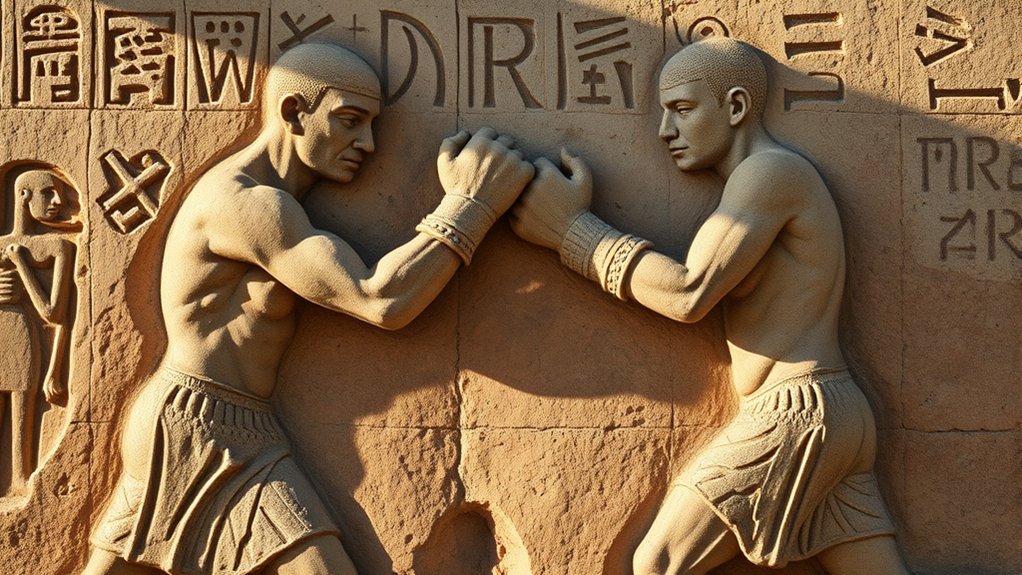
Boxing is over 4,000 years old, dating back to ancient civilizations like Mesopotamia and Egypt. Back then, fighters used simple leather straps to protect their hands. It’s amazing how such an old sport started with something so basic.
It developed further in ancient Greece, evolving from bare fists to leather thongs during the 688 BCE Olympic Games. Later on, Roman fighters made the sport more brutal by using studded gloves called cestus. That definitely took things up a notch.
Though boxing declined after the Roman Empire, its roots shaped the sport you know today. These ancient practices laid the foundation for modern boxing’s rules and techniques. Pretty cool to see how the past still influences the sport now!
Earliest Archaeological Evidence of Boxing
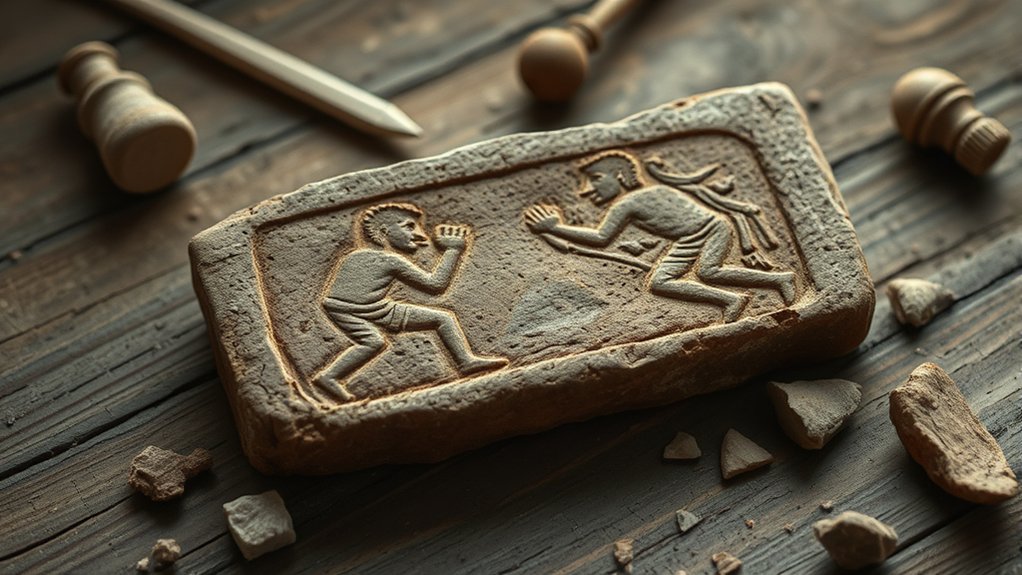
Although boxing feels like a modern sport, its roots stretch back thousands of years. The earliest archaeological evidence of boxing comes from Sumerian relief carvings dating to the 3rd millennium BCE, showing scenes of bare-knuckle fights. These carvings reveal some of the sport’s ancient origins, highlighting how boxing was already a recognized activity.
Ancient Egypt also contributed to this history, with frescoes from around 1350 BCE depicting boxers in competition. These boxing practices involved little to no hand protection, often just leather straps.
While these early depictions show boxing as a form of combat or ritual, it wasn’t until later, such as in Ancient Greece, that boxing became a formalized sport during the 688 BCE Olympic Games.
That marked its evolution from ancient origins to structured competition.
Development of Boxing in Ancient Egypt and Mesopotamia
You’ll find some of the earliest evidence of boxing in ancient Mesopotamia. Sumerian reliefs actually show fighters locked in combat, which is pretty fascinating.
On the other hand, ancient Egyptians also loved to capture boxing scenes in their art, especially around 1350 BCE in Thebes.
These depictions give us a glimpse into how both cultures shaped the brutal, bare-knuckled nature of early boxing. It’s interesting to see how this sport evolved in such different yet connected ways.
Earliest Boxing Evidence
When you explore the origins of boxing, you’ll find the earliest evidence in 3rd millennium BCE Mesopotamia, where Sumerian relief carvings vividly depict boxing scenes.
These ancient artworks reveal boxing as a recognized sport within Mesopotamian society, showcasing fighters engaged in combat with minimal hand protection. This raw brutality highlights how early boxing emphasized physical endurance and strength.
Over time, participants began using rudimentary hand coverings, marking a shift toward more organized boxing techniques. This evolution in Mesopotamia laid an important foundation in ancient history for the sport’s development.
Understanding this earliest evidence helps you appreciate boxing’s deep roots and its progression from bare-knuckle clashes to structured competition.
It also paved the way for later civilizations to refine and formalize the sport. So, when you look back, you can see how those early bouts shaped the boxing we know today. Pretty fascinating, right?
Egyptian Boxing Depictions
Stone carvings from ancient Egypt, dating back to around 1350 BCE, vividly portray boxing as a prominent activity in their society. These Egyptian depictions reveal fighters engaged in raw, bare-knuckle combat, emphasizing the brutality that defined early boxing.
Without much protective gear, the sport demanded toughness and skill, highlighting its significance as both a physical contest and a social spectacle.
As you explore these images, you see how boxing in ancient Egypt wasn’t just a pastime but a disciplined form of combat, echoing similar raw intensity found in other early civilizations.
These early boxing scenes laid essential groundwork for the sport’s evolution, showcasing a blend of physical endurance and raw aggression that shaped boxing’s ancient origins.
Mesopotamian Combat Scenes
Although boxing is often linked to ancient Egypt, its origins actually stretch back even further to Mesopotamia. There, 3rd millennium BCE relief carvings show combat scenes resembling early boxing matches. These Mesopotamian combat scenes reveal bare-knuckle fighting, a key early form of boxing, used both for physical training and ritual display.
This ancient sport emphasized strength and endurance, reflecting cultural values. Here’s a quick overview:
| Aspect | Mesopotamian Boxing | Egyptian Boxing |
|---|---|---|
| Era | 3rd millennium BCE | Around 1350 BCE |
| Fighting Style | Bare-knuckle, early forms | Bare-knuckle, minimal gear |
| Purpose | Physical training, ritual | Entertainment, training |
You can see how these early forms paved the way for boxing’s development across civilizations. It’s pretty fascinating to see how the sport evolved over time!
Boxing in Ancient Greece: From Bare Fists to Leather Thongs
Since its formal introduction at the 23rd Olympiad in 688 BCE, boxing in ancient Greece evolved from bare fists to using leather thongs that protected fighters’ hands while boosting their striking power.
When you watch ancient Greek boxing, you’ll see competitors relying heavily on striking skill, as clinching was forbidden. Matches had no rounds or weight classes and continued until one opponent surrendered, making endurance essential.
Despite leather thongs reducing some injuries, the sport remained brutal and dangerous, often resulting in significant harm.
Events took place outdoors, so you’d face not only your opponent but weather conditions too. This combination of physical challenge and cultural importance made boxing a key part of the Olympiad, showcasing athleticism and tenacity in ancient Greece.
Roman Boxing and the Brutal Cestus Glove
When you step into the world of Roman boxing, you quickly realize it’s a far cry from its Greek predecessor.
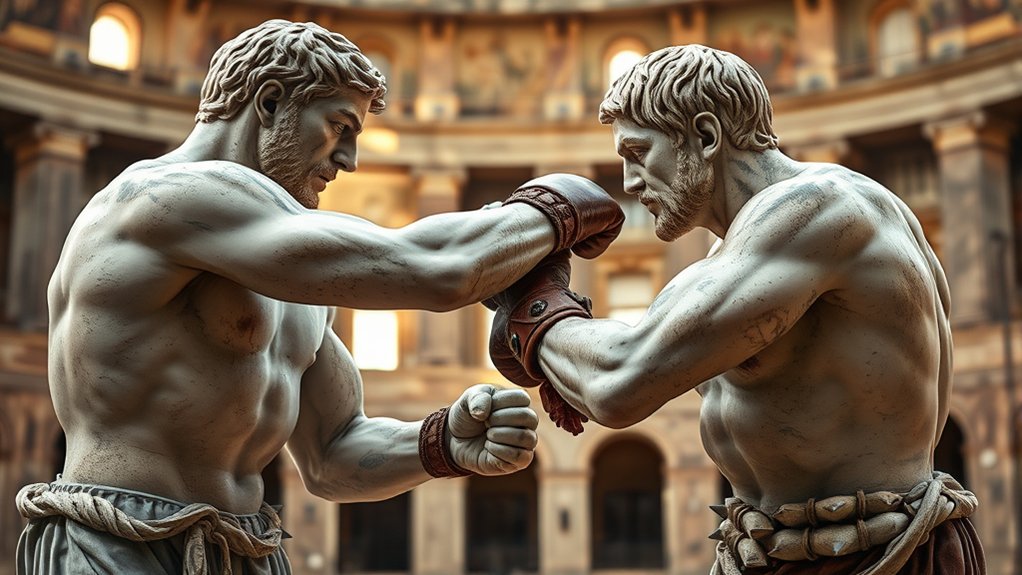
Roman boxing was brutal, featuring fighters who wore the cestus, a leather glove reinforced with metal studs designed to inflict severe injuries. Unlike Greek boxing’s focus on skill and endurance, Roman boxing lacked formalized rules and was unregulated.
Matches often continued until one combatant couldn’t go on. This brutality made it a popular part of gladiatorial contests, where fights often ended in serious harm or death.
The cestus turned bouts into deadly spectacles, emphasizing violence over technique.
If you imagine a sport driven by public entertainment rather than sportsmanship, Roman boxing’s harsh reality comes into sharp focus. It wasn’t just about winning—it was about survival and spectacle.
Decline of Boxing After the Roman Empire
After the Roman Empire fell, boxing really lost its spot in society. Part of the reason was that Christianity discouraged violent spectacles.
So, during the Medieval period, you’d see that the sport almost disappeared, replaced by other entertainments and different combat styles.
But then, by the 16th century in England, boxing began to make a comeback, setting the stage for the form we recognize today.
Boxing’s Medieval Obscurity
Though boxing thrived during the Roman Empire, it largely disappeared from public life throughout the Medieval period. You won’t find much evidence of organized boxing or formal combat sports in this era, as the sport fell into obscurity.
Bare-knuckle fighting did continue informally among certain groups, but these bouts lacked rules and structure. Without organized events, boxing faded from mainstream culture, replaced by chivalric tournaments and other forms of combat that seemed more fitting for the times.
This unregulated fighting often put lighter fighters at a disadvantage, highlighting the need for eventual reforms. So, while medieval boxing wasn’t completely extinct, it existed mostly in the shadows, far from the organized sport you recognize today.
Christianity’s Impact On Boxing
The decline of boxing during the Medieval period wasn’t just due to a lack of organized events. It was also shaped by the growing influence of Christianity.
After the fall of the Roman Empire, Christian values condemned the violence inherent in boxing and other blood sports. This moral stance led to the disappearance of organized boxing contests as the Church promoted peace and restraint instead.
You can see this impact in three key ways:
- Christianity condemned gladiatorial games and violent entertainment.
- Boxing’s brutal nature clashed with the Church’s teachings.
- The lack of codification of rules made boxing socially unacceptable.
As a result, boxing faded into obscurity throughout the Medieval period. Its revival and formal codification of rules only emerged centuries later.
Resurgence In 16th Century
When you look at boxing’s history, you’ll notice it nearly vanished following the fall of the Western Roman Empire. It disappeared from public life throughout the Medieval period. The sport saw a resurgence in 16th century England, but it was far from organized.
Fighters engaged in chaotic bare-knuckle bouts, often risking injury without formal rules. Prizefighting gained popularity, yet size and skill disparities made matches uneven. The need for order led to the Broughton Rules in 1743, marking boxing’s gradual return to structure.
| Period | Feature |
|---|---|
| Medieval Period | Boxing nearly extinct |
| 16th Century | Chaotic bare-knuckle bouts |
| Late 17th Century | Rise of prizefighting |
| Early 18th Century | Lack of formal rules |
| 1743 | Introduction of Broughton Rules |
Revival of Boxing in 16th-Century England’s Prizefights
If you picture boxing today, you might be surprised to learn it was revived in 16th-century England through chaotic bare-knuckle prizefights that drew huge crowds and heavy bets.
This revival lacked formal rules, making fights brutal and unpredictable. Fighters competed without weight divisions, often creating unfair matchups.
The prizefights, though disorderly, set the stage for more structured boxing later on. Key aspects to understand include the absence of boxing rules that led to intense, often dangerous bouts.
Jack Broughton, a pupil of James Figg, later introduced the first boxing rules, moving the sport toward structure.
These early prizefights in England ignited interest that eventually shaped organized boxing. You can see how England’s prizefights laid the groundwork for boxing’s evolution.
It’s pretty fascinating how those rough beginnings turned into the sport we know today.
Early Boxing Rules: Broughton and the London Prize Ring
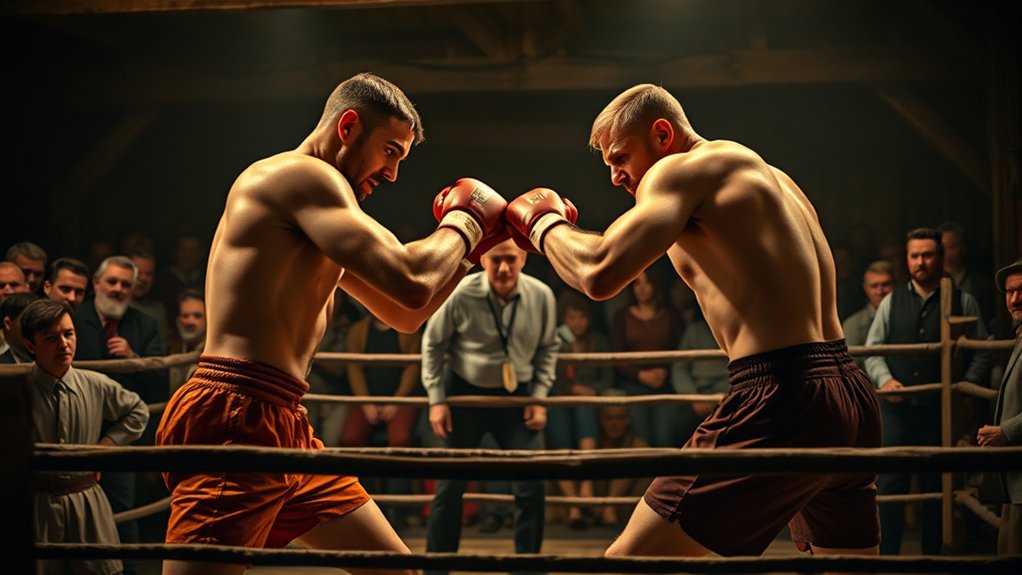
Although bare-knuckle prizefights thrilled spectators with their raw intensity, you’d find boxing far more orderly once Jack Broughton introduced his rules in 1743.
The Broughton Rules established structured practices, banning hitting downed fighters and hair-seizing. These changes protected bare-knuckle champions and shifted the sport toward modern boxing regulations.
Later, the London Prize Ring Rules, first set in 1838 and revised in 1853, further organized competition by defining a 24-foot ring and rounds ending when a fighter went down.
They also allowed a 30-second recovery. These rules reduced chaos and emphasized skill and agility over brute force.
This marked a clear evolution from earlier unruly bouts. Together, the Broughton and London Prize Ring Rules laid the essential groundwork that shaped boxing into a more disciplined and strategic sport.
It’s pretty clear how these early rules set the stage for the boxing we know today.
The Marquess of Queensberry Rules and the Birth of Modern Boxing
You’ll see how the Marquess of Queensberry Rules reshaped boxing by introducing gloves, timed rounds, and a standardized ring.
These changes pushed fighters to focus on skill and speed rather than just brute force.
It’s pretty interesting because before these rules, boxing was more of a bare-knuckle brawl — kinda chaotic and rough.
Understanding this shift helps you appreciate how boxing moved away from that chaos to the modern sport we recognize today.
Queensberry Rules Essentials
When the Marquess of Queensberry Rules were introduced in 1867, they transformed boxing by setting clear standards that prioritized skill and technique over sheer force.
These Queensberry Rules established a standardized framework that guaranteed every match was a fair stand-up boxing match, moving away from bare-knuckle brawling.
You’d notice mandatory boxing gloves protecting fighters, a roped-in square ring measuring 24 feet, and timed rounds with rest periods.
Also, the 10-second count gave fallen boxers a fair chance to recover, changing how bouts were judged. This foundational code still governs professional boxing today.
Key essentials include:
- Use of padded boxing gloves for safety
- Fighting within a roped-in square ring
- Enforcing the 10-second count for knockdowns
These rules shaped modern boxing’s integrity and structure.
Impact on Boxing Style
Since the Marquess of Queensberry Rules introduced gloves, timed rounds, and a structured ring, boxing shifted from raw brawling to a skillful, strategic sport. These rules emphasized technique and agility, changing the boxing style forever.
Padded gloves reduced injuries, allowing you to throw precise punches without risking severe harm. Timed rounds and safety measures like the 10-second count made boxing a safer, more competitive sport.
This framework laid the foundation for modern boxing’s history and style.
| Element | Impact on Boxing Style |
|---|---|
| Padded Gloves | Encouraged precise, strategic hits |
| Timed Rounds | Promoted endurance and pacing |
| Safety Measures | Increased fairness and longevity |
You now see how the Queensberry Rules shaped boxing into the sport you recognize today.
Transition From Bare-Knuckle
Although bare-knuckle boxing dominated for decades, the introduction of the Marquess of Queensberry Rules in 1867 revolutionized the sport. This alteration marked the birth of modern, gloved boxing, emphasizing skill over brute force.
The Queensberry Rules set clear standards: matches had to occur in a roped ring with timed rounds and banned wrestling and hitting downed opponents.
You’ll notice how this shift shaped boxing’s professional status and appeal through history. Key aspects of this alteration include structured rounds of three minutes with one-minute rests.
There was also the mandatory use of gloves to protect fighters and promote technique. Plus, the establishment of a 24-foot square ring helped contain the action.
These changes transformed boxing into a refined, strategic sport, moving away from bare-knuckle chaos. It really set the stage for the boxing we know today.
Differences Between Ancient and Modern Boxing Practices
While ancient boxing emphasized endurance and brutal force, modern boxing focuses on technique, safety, and fairness.
In the ancient Greek sport, fighters wrapped their hands in leather thongs for minimal protection, unlike today’s padded gloves designed to reduce injury. Ancient matches lacked structured rounds and continued until one conceded defeat.
On the other hand, modern professional boxing uses timed rounds and breaks. Rules introduced in the late 19th century, such as the Marquess of Queensberry Rules, standardized the sport.
These rules prohibited dangerous equipment like the metal-studded cestus of ancient Rome.
Modern boxing also features weight classes and referees to guarantee fairness and safety. This contrasts sharply with the unregulated, often chaotic contests of ancient times.
Understanding these differences highlights how boxing evolved from raw combat to a regulated, skill-driven sport.
Ancient Boxing’s Influence on Today’s Sport
Understanding how ancient boxing practices shaped today’s sport helps you appreciate the roots of modern techniques and rules. The influence of Greek boxing and other ancient origins is clear in how the sport evolved.
You’ll notice that today’s boxing still echoes those early forms through the emphasis on strength and endurance, which was a hallmark of ancient Greek boxing.
The protective gloves and timed rounds introduced by the Marquess of Queensberry Rules refined safety and strategy.
Plus, the fighting techniques we see today balance offense and defense, and they’re rooted in both Greek and Roman combat styles.
It’s fascinating how these old traditions still impact the sport we watch now.
Frequently Asked Questions
What Training Methods Did Ancient Boxers Use?
You’d use various training techniques, like endurance drills such as running and wrestling to boost stamina.
Strength training involved heavy bags filled with sand or stones, improving your punching power.
Sparring sessions helped you practice timing and defense with partners.
Mental preparation was key, sharpening your focus before matches.
Historical equipment like leather straps protected you, while coaching styles emphasized discipline and technique to make you a well-rounded ancient boxer.
Were Women Allowed to Participate in Ancient Boxing?
You won’t find female participation in ancient boxing due to strict gender roles and cultural significance tied to male-only competition.
Historical records show boxing was reserved for men, reflecting social status and ancient traditions that excluded women.
While notable athletes were all male, some rare instances in Rome hint at female gladiators engaging in boxing-like combat.
How Did Ancient Boxing Impact Local Economies?
You’ll see that ancient boxing boosted local economies by driving spectator revenue and stimulating the boxing trade.
Community events attracted crowds, which increased activity in local markets and created economic benefits for merchants and craftsmen.
Artisans used their craftsmanship skills to produce gloves and gear, further supporting the economy.
Beyond money, boxing’s cultural significance united people, making these events essential for both social and economic growth in ancient societies.
What Role Did Religion Play in Ancient Boxing Matches?
You’ll find that religion played an essential role in ancient boxing matches by turning them into sacred rituals.
These events weren’t just about the competitive spirit; they symbolized seeking divine favor through athletic dedication. Boxing carried deep cultural significance, often serving as community events that united people.
Historical records show how these matches honored gods and reinforced social bonds, making boxing much more than just a physical contest in those times.
It was about connecting with something greater and celebrating shared beliefs.
Did Ancient Boxers Have Specific Diets or Nutrition Plans?
Yes, ancient boxers followed specific dietary practices to boost performance. You’d focus on nutrition sources like meat, grains, and fruits to maintain energy balance.
Meal timing mattered, with meals planned around training to optimize strength and recovery. Hydration strategies and food rituals helped sustain stamina during matches.
You’d also rely on recovery foods to repair muscles after intense bouts. It really shows how seriously they took diet as part of their training regimen.
Conclusion
You might be surprised to learn that boxing dates back over 5,000 years, with evidence found in ancient Mesopotamian reliefs. This long history shows how the sport evolved from brutal bare-knuckle fights to the regulated matches you see today.
Understanding its ancient origins, like the Roman cestus gloves, helps you appreciate how boxing’s raw intensity shaped modern rules. So next time you watch a fight, remember you’re witnessing a tradition thousands of years in the making.


